*This article is for informational purposes only and does not constitute veterinary advice. Always consult your veterinarian before selecting a mobility aid for your dog.
Every website says the same thing: 2–4 hours a day. That's the number you'll find on every dog wheelchair FAQ page on the internet. And it's correct — but it's about as useful as telling someone who's never cooked before that dinner takes 30 minutes. Which dinner? Starting from where? With what equipment?
The number that actually matters on Day 1 is 10 minutes.
Dachshunds Are Not Small Dogs in Wheelchairs. They're Dachshunds in Wheelchairs.
Most usage guides treat all wheelchair dogs the same. A 20 lb Dachshund and a 20 lb Corgi get the same advice. But the physics are different.
In a rear-support wheelchair, the front legs do all the propulsion. A Corgi's front legs pull their body weight across a relatively short, compact torso. A Dachshund's front legs pull the same weight across a torso that's 2 to 3 times longer than their leg height. The lever arm is longer. Each stride costs more energy. Over 30 minutes, the difference is small. Over an hour, it compounds.
There's a second factor that's almost never discussed: ground clearance. Dachshund wheelchair wheels sit as low as 6 inches off the ground on an XXS frame. On anything other than smooth pavement, the wheels encounter more surface resistance relative to the dog's small forward momentum. A Dachshund on short grass is working harder than a taller dog on the same surface at the same weight.
This doesn't mean shorter sessions forever. It means a more gradual build-up, and different fatigue signals to watch for — particularly one that's specific to Dachshunds and that no generic guide mentions. More on that below. For a broader overview of Dachshund wheelchair sizing and setup, the Complete Dachshund Wheelchair Guide covers that ground in full.
The Build-Up: From 10 Minutes to a Full Routine
Stage 1: Days 1–3 — Introduction
| Day | Sessions | Session length | Total daily time |
|---|---|---|---|
| 1 | 1–2 | 10–15 min | 10–20 min |
| 2 | 1–2 | 10–15 min | 15–25 min |
| 3 | 2 | 15–20 min | 30–40 min |
Indoor only. Carpet or textured flooring.
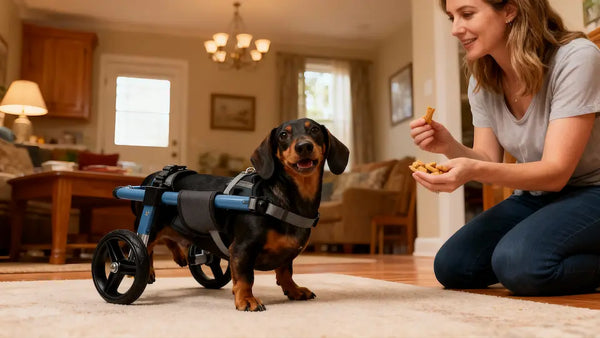
Session quality matters more than session length at this stage. A 10-minute session that ends with your Dachshund standing calmly is more productive than a 20-minute session that ends with them backing out of the harness. Most Dachshunds don't move forward at all during Days 1–2, and that's completely typical for the breed.
Stage 2: Days 4–7 — The Shift
| Day | Sessions | Session length | Total daily time |
|---|---|---|---|
| 4 | 2 | 15–20 min | 30–40 min |
| 5 | 2 | 20–25 min | 40–50 min |
| 6 | 2–3 | 20–25 min | 45–60 min |
| 7 | 2–3 | 20–30 min | 50–75 min |
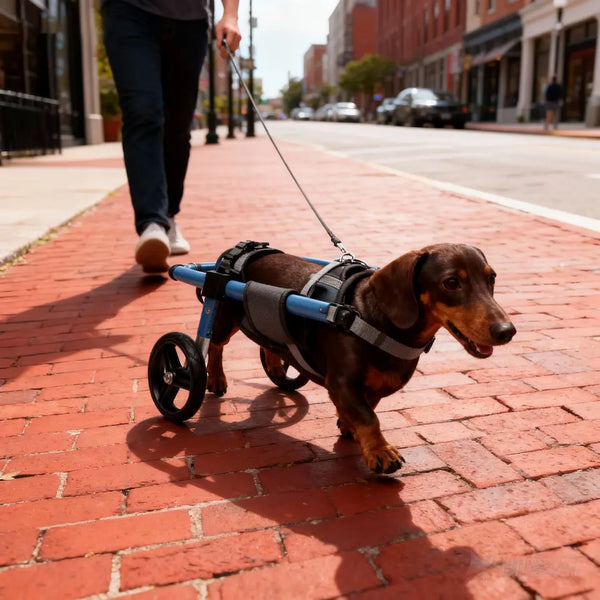
First outdoor session on smooth pavement from Day 6.
Day 5 is typically when Dachshunds commit. The "click" — when movement shifts from reluctant to natural — tends to arrive about a day later in Dachshunds than in most other breeds. If it hasn't happened by Day 5, don't increase session length. Keep sessions at 15–20 minutes, keep using the treat trail, and let it come. It almost always does by Day 7. For a realistic day-by-day picture of what this adaptation process looks like, the Day 1 to Day 7 guide covers exactly what to expect each day.
The temptation during this phase is to reward progress by extending sessions quickly. Resist it. The front legs aren't conditioned yet, and the confidence is new. End each session while your dog still wants more.
Stage 3: Weeks 2–3 — Stamina Building
| Week | Sessions | Session length | Total daily time |
|---|---|---|---|
| 2 | 2–3 | 25–35 min | 60–90 min |
| 3 | 2–3 | 30–45 min | 90–120 min |
Pavement and short grass. One new surface at a time.
This is the stage where front leg fatigue becomes relevant. Watch for the signal described below — front legs splaying outward or elbows sinking. If you see it, you've found your dog's current limit. Note the time, keep future sessions a few minutes shorter, and let stamina catch up naturally.
Stage 4: Week 4 Onward — Stable Routine
| Routine type | Sessions | Session length | Total daily time |
|---|---|---|---|
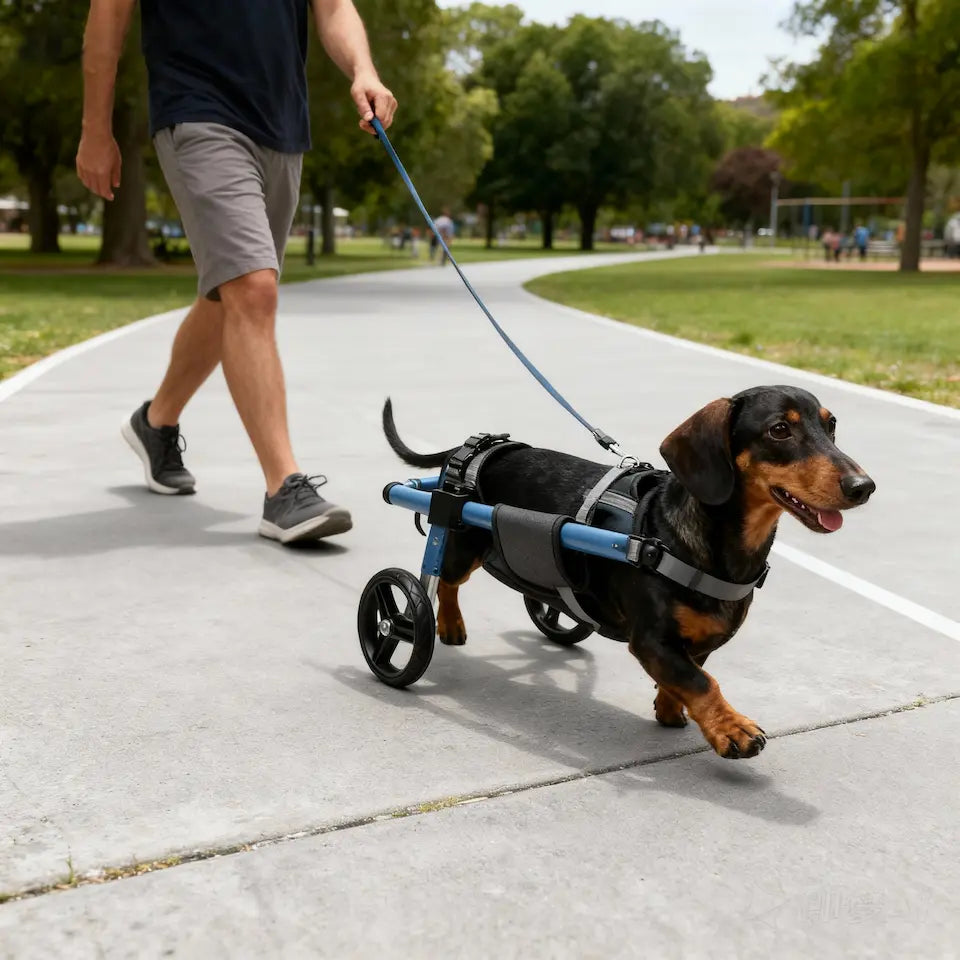
| Typical | 2–3 | 30–60 min | 2–4 hours |
| Light (senior / low stamina) | 2 | 20–30 min | 1–1.5 hours |
| Active (younger / high energy) | 3 | 45–60 min | 2.5–4 hours |
One pattern we've seen consistently from owner feedback: Dachshunds do better with three shorter sessions than two longer ones. A 30-minute morning walk, a 15-minute midday trip, and a 30-minute evening session gives the front legs more recovery time between efforts than two 40-minute blocks — even though the total is similar. The rest gaps matter more for this breed than for dogs with proportional builds.
The Signal That Generic Guides Miss Entirely
Every wheelchair usage guide will tell you to watch for slowing down, heavy panting, and trying to lie down. Those are all valid. But there's a fifth signal that's specific to Dachshunds, and it's the one that matters most for preventing front leg strain.
Front legs splaying outward, or elbows sinking lower than normal during movement.
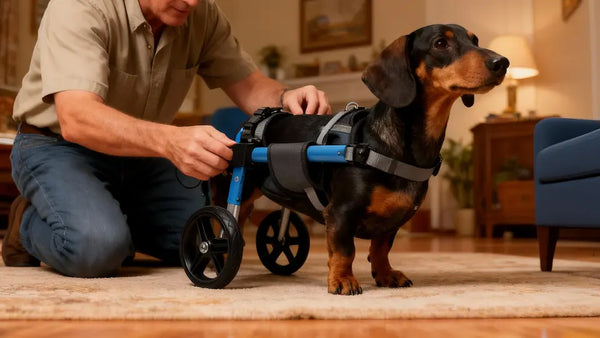
When you see this, your Dachshund's front leg muscles have reached their limit for this session. The long torso has been loading those legs for long enough that the muscles can no longer hold the normal tracking position. It's not a fit problem — if you're unsure whether the harness is contributing, our fitting guide walks through how to check each contact point — and it's not a motivation problem. It's biomechanical fatigue.
End the session immediately when you see it. Not with drama — just calmly take the wheelchair off and let your dog rest. If you see it at the 25-minute mark three sessions in a row, that's your dog's current ceiling. Respect it. The ceiling moves on its own over weeks of consistent daily use.
The other four fatigue signals, for completeness:
Pace drops noticeably compared to the first half of the session. Still moving, but dragging.
Panting while standing still. Panting during movement is normal. Panting without moving means the body is asking for a break.
Attempting to lower toward the ground. The wheelchair doesn't allow lying down, so when your dog tries, the message is unambiguous.
Treats stop working. A Dachshund ignoring food placed directly in front of them has hit their wall. For a breed this food-motivated, that's a definitive signal.
What a Stable Day Actually Looks Like
Once you're past the first month, the wheelchair becomes background routine — not an event. A typical day for a Dachshund on a stable wheelchair routine:
Morning: wheelchair on for the outdoor walk and bathroom trip. 30–45 minutes depending on the route and the dog's energy. Wheelchair off, rest.
Midday: a short session — sometimes just a quick wheelchair trip to the yard for a bathroom break, sometimes a 15-minute indoor session. Wheelchair off, rest.
Evening: wheelchair on for the second real walk of the day. 30–45 minutes. Wheelchair off for the evening and overnight.
Total active time: roughly 1.5 to 2.5 hours on a normal day. Some dogs reach 3–4 hours on particularly active days. Some plateau happily at an hour. Both are fine.
The wheelchair is always off for unsupervised rest, naps, and overnight sleep. Always. For more on the day-to-day logistics of potty breaks, rest periods, and indoor versus outdoor use, see Daily Life with a Dog Wheelchair.
A Note on Consistency
A Dachshund who uses their wheelchair for 45 minutes every day will build stamina faster and more sustainably than one who does two hours on Saturday and nothing during the week. The front legs need consistent, moderate loading to condition. Sporadic heavy use followed by rest days is harder on the body.
If you can only manage one short session on a busy day, that's still better than skipping entirely. The habit matters more than the duration on any individual day.
Frequently Asked Questions
Q: How long can a Dachshund wear a wheelchair each day?
Most reach a stable routine of 2–4 hours of total daily use, split into 2–3 sessions. This is built gradually over 3–4 weeks, starting at 10–15 minutes on Day 1. Some Dachshunds are most comfortable at 1–1.5 hours per day.
Q: My Dachshund only lasts 15 minutes. Is something wrong?
Not necessarily. Seniors, smaller Miniatures, and new wheelchair users often have lower initial stamina. If your dog is comfortable during those 15 minutes, it's a successful session. Stamina builds over weeks. Discuss with your veterinarian if you're concerned.
Q: Should my Dachshund use the wheelchair every day?
Yes. Daily use builds stamina and keeps the wheelchair a normal part of life. Skipping days can disrupt adaptation, particularly in the first two weeks.
Q: Can my Dachshund sleep in the wheelchair?
No. Remove it for all rest periods. Dogs need to lie down in their natural position for recovery.
Q: Does a 4-wheel setup change the schedule?
A quad wheelchair distributes weight more evenly, which can reduce front leg fatigue. Some dogs tolerate moderately longer sessions. The same fatigue signals apply. For guidance on whether rear or front support is the right starting point for your dog, see our rear vs front wheelchair guide.
Q: Is there a maximum daily limit?
Most veterinary guidance suggests 4 hours total as a reasonable upper limit for fully adapted dogs, split across sessions. Follow your dog's signals and your vet's recommendations rather than a fixed number.
References
- "Evidence for canine rehabilitation and physical therapy." Vet Clin North Am Small Anim Pract. 2015;45(1):1-27. PubMed