*This article is for informational purposes only. Always consult your veterinarian before introducing any mobility aid to your dog's routine.
You've done the research. You've ordered the dog wheelchair. You've watched the videos of dogs zooming around happily on their wheels, tail wagging, owners cheering.
And then Day 1 arrives — and your dog just stands there. Or sits down. Or looks at you like you've completely lost the plot.
Here's what most guides won't tell you upfront: the first week in a dog wheelchair is not a highlight reel. It's a week of small moments, unexpected setbacks, and quiet breakthroughs that you almost miss. It is also, for most dogs and owners, one of the most meaningful weeks they share together.
This is an honest account of what that week actually looks like — the parts nobody puts in the promotional video.
Before Day 1: The Expectation Gap
The biggest source of frustration in the first week isn't the wheelchair. It's the gap between what owners expect and what actually happens.
Most people expect their dog to instinctively understand what the wheelchair is for and start moving confidently within the first session. What actually happens is that your dog encounters a strange object attached to their body that restricts their usual movement patterns. Their first instinct is caution — sometimes complete stillness.
This is not failure. This is a completely normal response to something unfamiliar.
Closing the expectation gap before Day 1 is the single most useful thing you can do to prepare. The week ahead is a gradual process, not a single moment of transformation. Once you accept that, everything that follows feels very different.
Day 1: Nothing Goes the Way You Planned
What people expect: Their dog takes their first steps and the moment is captured perfectly on video.
What usually happens: The dog freezes. Or sits down immediately. Or takes two steps and then tries to back out of the harness.
All of this is normal. On Day 1, your only real goal is to end the session on a positive note — even if that means the session lasts four minutes.
What actually matters on Day 1:
Let your dog sniff and investigate the wheelchair before it goes on. Dogs orient to the world through smell first. An object that smells familiar is far less threatening than one that doesn't. Leave it on the floor near their bed the night before if you can.
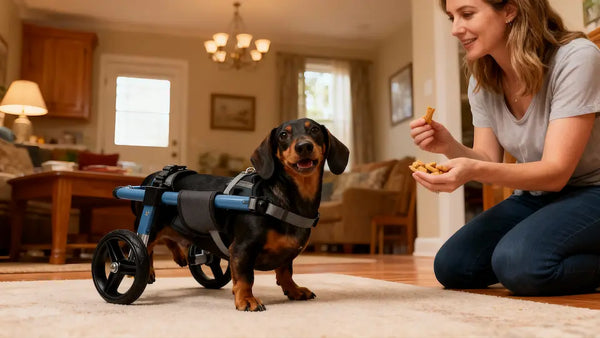
Keep the first session short — 10 to 15 minutes maximum. Put the wheelchair on, reward immediately with a high-value treat, and stay calm. Your emotional state communicates directly to your dog. If you're anxious about whether it's working, they'll pick that up.
The moment you're actually looking for on Day 1 isn't forward motion. It's your dog accepting the wheelchair on their body without significant distress. That's a win.
Day 2: The First Real Steps (and Why They Look Wrong)
Most dogs take their first real forward steps on Day 2. And most owners immediately worry that something is wrong.
The steps look uneven. The dog moves sideways, or in a curved line, or takes a few steps and then stops completely. The wheelchair seems to be pulling them in a direction they didn't intend.
This is coordination learning, not a fitting problem. Your dog is working out how to integrate the wheelchair's weight and width into their movement. The brain is recalibrating. It looks awkward because it is awkward — in exactly the same way a person looks awkward the first time they use crutches.
One thing that consistently works on Day 2: a trail of small treats on the ground. Don't lure from above or call them toward you — let the treats on the floor draw them forward naturally at their own pace. Forward movement driven by curiosity or appetite is far more relaxed than forward movement driven by responding to a command.
What not to do: Don't pull the leash forward. This creates resistance rather than forward momentum and can make your dog associate the wheelchair with being pulled rather than moving independently.
Day 3: The Harness Check You Probably Forgot
By Day 3, most owners are focused on progress — longer distances, smoother movement, outdoor possibilities. What they often forget is that the harness fit needs to be rechecked.
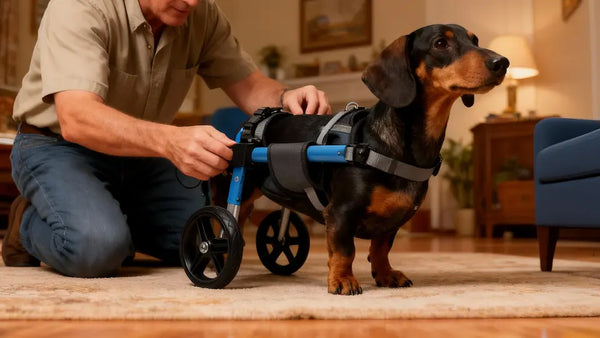
After two days of movement and adjustment, straps shift. Your dog's posture in the wheelchair may have changed slightly as they've relaxed into it. A harness that felt right on Day 1 may have loosened — or may be sitting differently because your dog is now actually moving rather than standing still.
The two-finger rule: Run two fingers between the harness strap and your dog's body at several points. You should be able to fit two fingers comfortably. If you can fit three or more, tighten the strap. If you struggle to fit one, loosen it.
Also recheck the spine position from the side. It should be horizontal — a level line from shoulders to hips. If the rear end is tilting down or up, the wheel height needs adjusting.
Spending five minutes on this check on Day 3 prevents a lot of the resistance and reluctance that owners often notice in the middle of the first week.
Day 4: The Day Many Owners Want to Give Up
Day 4 is statistically the hardest day of the first week. Not because anything goes wrong — but because progress stalls.
Days 1 to 3 have a clear narrative arc: first session, first steps, growing confidence. Day 4 often feels flat by comparison. Your dog may seem less enthusiastic than they were on Day 3. They may resist going in the wheelchair at the start of the session. You start wondering whether the wheelchair is actually right for them, or whether you're pushing too hard.
What's actually happening is consolidation. The brain is integrating everything learned in the first three days. A plateau after rapid early progress is a completely normal part of any learning process — in dogs as much as in people.
Two things that help on Day 4:
First, introduce social interaction. If your dog has a canine friend, let them sniff each other with the wheelchair on. Other dogs' curiosity tends to shift the wheelchair from "strange thing attached to me" to "interesting object that my friend is also investigating." The normalisation that comes from another dog's relaxed reaction is remarkably effective.
Second, change the location. A different room, the garden, a new patch of outdoor space. Novel environments engage curiosity and tend to get dogs moving more naturally than familiar spaces where they have established rest spots.
Day 5: The Shift You've Been Waiting For
Most owners describe Day 5 as the day something clicks.
It's not always dramatic. It might be a longer uninterrupted stretch of forward movement. It might be your dog navigating a turn they'd been struggling with. It might just be that they walk toward the wheelchair when you bring it out rather than away from it.
Whatever form it takes, Day 5 usually contains a moment where it becomes clear that your dog has genuinely started to understand what their wheels are for.
Safe indoor play setup for Day 5:
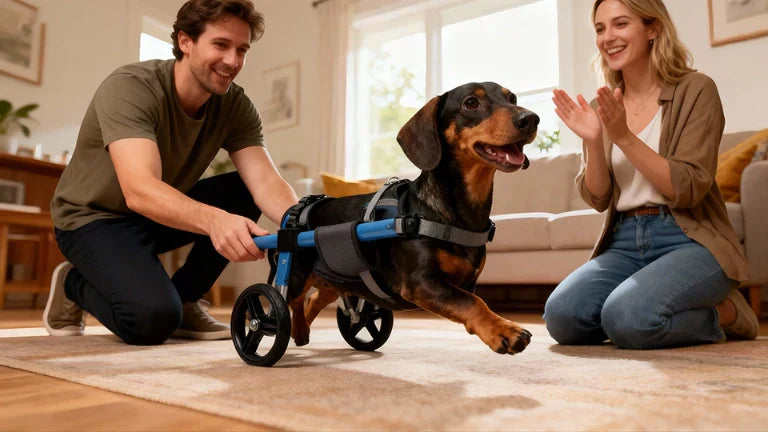
By now, your dog is ready to start connecting the wheelchair with activities they enjoy — not just with structured sessions. Clear the floor of obstacles, cords, and anything they could catch a wheel on. Create open space. Bring out a favourite toy and let them engage with it while wearing the wheelchair. The goal is for movement to feel purposeful and enjoyable rather than something that happens during "wheelchair time."
Day 6: Going Outside for the First Time
The first outdoor session is a milestone — and it also tends to recalibrate your sense of how far your dog has come.
Indoors, they've been navigating familiar carpet or flooring. Outside, everything is different: the surface texture changes, there are new smells, passing distractions, uneven ground. Many dogs who've been moving confidently indoors become cautious again outdoors.
This is not regression. It's the same learning curve, applied to a new environment.
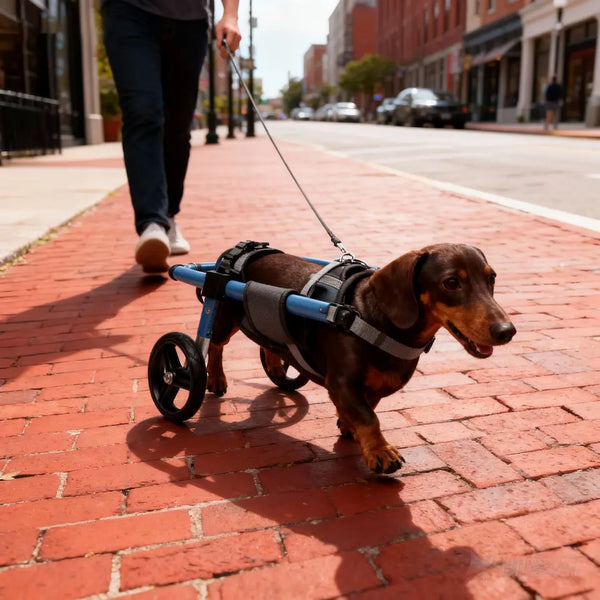
Start on smooth pavement. Your dog's back garden or a quiet section of flat pavement nearby is ideal. Keep the first outdoor session short — 15 to 20 minutes — and focus on letting them explore at their own pace rather than covering distance.
Surface progression:
-
Days 6–7: Smooth pavement or flat paving slabs
-
Week 2: Short grass once confidence on pavement is established
-
Week 3+: Uneven surfaces, gravel, varied terrain
Trying to rush this progression is one of the most common mistakes in the first week. Smooth pavement first. Everything else can wait.
Day 7: What Progress Actually Looks Like
By Day 7, most dogs are not zooming around effortlessly. What they are is noticeably more confident, more willing, and more natural in their movement than they were on Day 1.
The transformation worth noticing isn't speed or distance. It's the absence of the resistance and confusion that characterised Day 1. A dog who now walks calmly toward their wheelchair, who takes it in stride as part of their daily routine, has made enormous progress — even if it doesn't look like the videos.
The honest end-of-week reality check:
|
What most owners expect by Day 7 |
What actually happens |
|
Confident, fast independent movement |
Steady, increasingly natural movement |
|
No more hesitation |
Hesitation in new environments, less in familiar ones |
|
Full 2–4 hour daily sessions |
Building toward 1–2 hours in multiple sessions |
|
Problem fully solved |
Foundation firmly established |
The first week builds the foundation. The weeks that follow are where the real fluency develops.
The One Thing That Makes the Biggest Difference
Across everything that happens in the first week, one factor consistently separates the dogs who adapt quickly from those who struggle: the owner's calm.
Dogs are exquisitely sensitive to human emotional states. An owner who is anxious about whether the wheelchair is working communicates that anxiety directly. An owner who approaches each session with genuine calm patience — even when progress is slow — creates the emotional environment where a dog can relax enough to actually learn.
You don't need to perform enthusiasm. You just need to mean it when you're calm.
What Comes After the First Week
The first week in wheels is a beginning, not a destination. Most dogs are still developing their fluency in weeks two and three. Longer sessions, more varied terrain, and genuine integration into daily routine typically emerge over the first month rather than the first week.
For a complete day-by-day breakdown of what to do in each session — including specific techniques for Days 1 through 7 — see our First Week in Wheels guide.
If you're still in the process of choosing the right wheelchair for your dog, our fitting guide covers the three measurements and checks that make the biggest difference to how quickly your dog adapts.
Frequently Asked Questions
Q: My dog refuses to move at all in the wheelchair. Is something wrong?
Complete stillness on Day 1 is normal and doesn't indicate a problem with the wheelchair or your dog. Check that the fit is correct — particularly the spine position and harness snugness — and keep the session short. Most dogs who are completely still on Day 1 are taking their first steps by Day 2 or 3.
Q: How long should each session be in the first week?
Start with 15 to 20 minute sessions in the first two days. Increase gradually based on your dog's energy and willingness — not on a fixed schedule. Most dogs are comfortably using the wheelchair for 1 to 2 hours per day in multiple sessions by the end of week one.
Q: My dog seemed to be progressing well and then got worse on Day 4. Is this normal?
Yes. A plateau or temporary dip in enthusiasm around Days 3 to 5 is extremely common. It reflects consolidation of learning rather than regression. Changing location and introducing social interaction are the two most effective responses.
Q: Should I be worried if my dog's steps look very uneven?
Uneven or sideways steps in the first two to three days are coordination learning, not a sign of incorrect fit (though it's always worth rechecking the harness). The movement pattern typically becomes noticeably smoother between Days 3 and 5.
Q: When can my dog go outside?
Most dogs are ready for their first brief outdoor session on Day 6 of the first week, once they're moving comfortably indoors. Start on smooth flat pavement and keep the first outdoor session to 15 to 20 minutes.
One Last Thing
The first week is hard in ways that don't show up in the promotional videos. It requires patience you didn't know you had, and it asks you to redefine what progress looks like on a daily basis.
What it gives back, by Day 7, is the clear sense that your dog is on their way. Not there yet — but genuinely, unmistakably, on their way.
That's worth every slow session, every frozen moment, every treat-trail on the kitchen floor.
For the complete day-by-day session guide with photos, visit The First Week in Wheels.