*This article is for informational purposes only and does not constitute veterinary advice. Always consult your veterinarian before introducing any mobility aid to your dog's routine.
If your dog has started showing changes in their mobility, you've probably come across two main types of support: dog wheelchairs and back support vests. Both are designed to help dogs stay active and engaged in daily life — but they do very different things, and choosing the right one at the right time makes a real difference to how smoothly your dog adapts.
This guide breaks down exactly what each aid does, when each one is most useful, and how many owners end up using both as part of a complete daily routine.
The Core Difference in One Sentence
A wheelchair enables independent movement when a dog's legs can no longer do the job on their own. A back support vest assists movement when a dog's legs still work but need additional stability or owner-assisted support.
That's the fundamental distinction. Everything else flows from it.
What Each Aid Actually Does
Dog Wheelchair
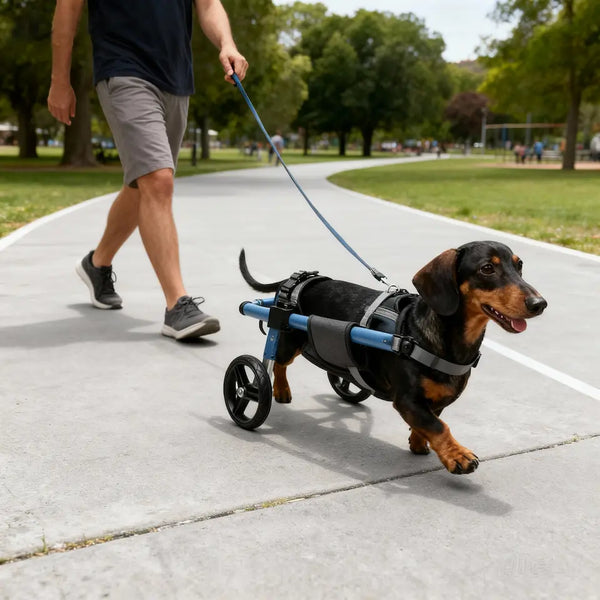
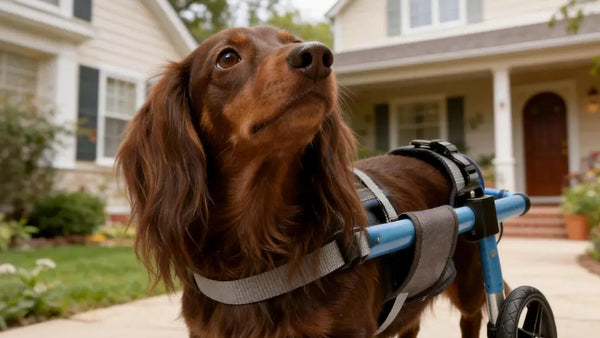
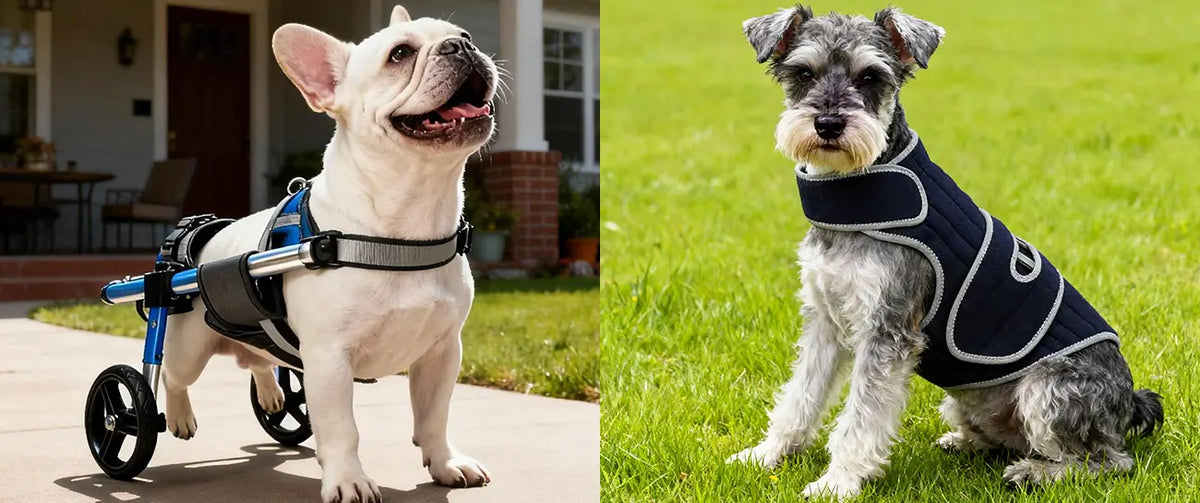
A dog wheelchair is a frame-and-wheel system that attaches to the dog's body via a harness, supporting the hindquarters (rear-support model) or the full body (4-wheel model) while the dog moves independently using their functional legs.
Key characteristics:
- Enables fully independent movement for extended periods
- Dog propels themselves forward using their front legs (in a rear-support setup)
- Designed for active use: walks, outdoor exploration, play, social time
- Typically used in supervised sessions of 30 minutes to several hours per day
- Removed during rest periods and sleep
A wheelchair is the primary tool for dogs who need to move independently when their hind legs — or all four legs — are no longer providing reliable support.
Back Support Vest
A back support vest is a wearable garment that wraps around the dog's torso, supporting the back, chest, and hindquarters in a natural posture. It does not replace leg function — it supports whatever function remains and gives owners a secure point from which to assist.
Key characteristics:
- Supports the dog's existing mobility rather than replacing it
- Provides postural stability during movement
- Gives the owner secure leverage for lifting assistance (stairs, vehicles, standing up from rest)
- Lightweight and easy to put on and take off for frequent daily use
- Designed for transitional moments and lower-intensity activity
A vest is the primary tool for the parts of the day that fall between wheelchair sessions — and for dogs who are still mobile but benefit from added stability.
When to Use Which: A Practical Comparison
The following table reflects general patterns based on common usage. Your veterinarian is best placed to recommend the right approach for your individual dog.
|
Situation |
Wheelchair |
Back Support Vest |
|
Extended outdoor walks (30+ minutes) |
✓ Primary tool |
Can be worn underneath |
|
Independent movement and play |
✓ Primary tool |
|
|
Rising from rest (lying to standing) |
✓ Primary tool |
|
|
Navigating stairs or steps |
✓ Primary tool |
|
|
Getting in and out of vehicles |
✓ Primary tool |
|
|
Short indoor movement between rest periods |
Optional |
✓ More practical |
|
Outdoor bathroom breaks (quick trips) |
Either — depends on the dog |
✓ Often more convenient |
|
Hind legs significantly weakened but some function remains |
✓ For active sessions |
✓ For transitions |
|
Little or no independent hind leg function |
✓ Primary tool |
Supplementary support |
The key takeaway: these two aids cover different parts of the day and different types of movement. Choosing between them is often less useful than understanding when each one is most practical.
The Most Common Mistake Owners Make
The mistake that sets dogs back isn't choosing the wrong product — it's choosing only one when the situation calls for both.
Here's how it typically plays out: an owner recognises that their dog needs mobility support and purchases a wheelchair. The wheelchair works well for outdoor sessions and active movement. But between sessions — when the wheelchair is off — the dog struggles with everyday transitions: standing up from rest, navigating the step out the back door, getting into the car for a vet visit.
These in-between moments add up. A dog who is well-supported during active sessions but unsupported during daily transitions can lose confidence and take longer to build the overall routine that keeps them active and engaged.
A support vest fills these gaps. It doesn't replace the wheelchair — it covers the parts of the day that the wheelchair isn't designed for.
What a Typical Day Looks Like with Both
For owners who use both aids, a typical daily routine often follows a pattern like this:
Morning
- Vest on for the morning transition: rising from bed, short walk to the door, navigating any steps to get outside
- Switch to wheelchair for the morning outdoor session (walk, bathroom, exploration) — 20 to 40 minutes
- Wheelchair off, vest on for the return inside and settling into a rest spot
- Vest off during supervised rest
Midday
- Vest on for a short indoor trip (bathroom break, moving between rooms, brief play)
- Vest off during rest
Afternoon / Evening
- Vest on for transitions
- Wheelchair on for the afternoon outdoor session
- Wheelchair off, vest on for the evening routine
- Vest off for overnight sleep
This isn't a rigid schedule — it adapts to each dog's energy, routine, and needs. The point is that both aids have distinct roles throughout the day, and together they create a more complete support structure than either one alone.
Starting with One and Adding the Other
Not every dog needs both aids from day one. The progression depends on where your dog is and should be guided by your veterinarian's assessment.
Starting with a wheelchair first
If your dog's hind leg function has already changed significantly — to the point where independent movement without support is limited — a wheelchair is typically the right starting point. It addresses the most immediate need: getting your dog moving again. Once the wheelchair routine is established (usually within the first two to three weeks), adding a vest for transitions and indoor movement becomes a natural next step.
Starting with a vest first
If your dog is still walking independently but showing early signs of reduced stability — wobbling, hesitation on stairs, slower to stand — a vest may be the practical first step. It supports current mobility while the dog's situation is being monitored by your veterinarian. If hind leg function changes further, adding a wheelchair for active sessions builds naturally on the vest foundation.
Using both from the start
For dogs in the middle — still mobile for short periods but needing significant support for longer sessions — introducing both aids at the same time can work well. The vest handles the lighter-duty moments, the wheelchair handles the active sessions, and the dog adapts to both simultaneously.
Sizing Quick Reference
Both aids require accurate measurements for a correct fit. Here's a quick reference for what you'll need.
Wheelchair Sizing
Three measurements determine wheelchair fit:
|
Measurement |
How to measure |
|
Height (withers to ground) |
Floor to the top of the shoulder blade, standing on a flat surface |
|
Length (rear thigh to front shoulder) |
Along the side of the body, from mid-thigh to front shoulder |
|
Width (widest point) |
Across the widest point of the body viewed from above |
Full sizing details: Wheelchair Measuring Guide
Back Support Vest Sizing
Four measurements determine vest fit:
|
Measurement |
How to measure |
|
Neck Girth |
Around the neck at mid-point |
|
Chest Girth |
Around the widest part of the chest, behind the front legs |
|
Back Leg Girth |
Around the upper hind leg at its widest point |
|
Back Length |
Along the top of the back, base of neck to base of tail |
|
Size |
Neck Girth |
Chest Girth |
Back Leg Girth |
Back Length |
|
S |
8–12 in |
12–20 in |
8–12 in |
11–13 in |
|
M |
12–18 in |
16–28 in |
11.5–18 in |
16–19 in |
|
L |
14–22 in |
22–39 in |
16–23 in |
17–20 in |
|
XL |
18–27 in |
25–46 in |
22–30 in |
22–25 in |
Frequently Asked Questions
Q: Can my dog wear a support vest and use a wheelchair on the same day?
Yes — this is one of the most common and practical approaches. The vest covers transitions and indoor movement, the wheelchair covers active outdoor sessions. Many owners use both every day as part of a complete routine.
Q: Should I buy the wheelchair or the vest first?
It depends on your dog's current mobility level. If hind leg function is significantly reduced, start with the wheelchair. If your dog is still walking but showing reduced stability, a vest may be the practical first step. Your veterinarian can help you determine where your dog is on this spectrum.
Q: Does using a vest delay the need for a wheelchair?
A vest supports current mobility — it doesn't change the underlying situation. Whether and when a wheelchair becomes relevant depends on your dog's specific condition, which your veterinarian is best placed to assess. Think of the vest as a complement to the wheelchair, not a replacement.
Q: My dog only has trouble with stairs and getting into the car. Do I need a wheelchair?
If your dog walks independently on flat surfaces and only struggles with specific transitions, a support vest may be sufficient for those moments. It provides the postural support and owner-assisted leverage needed for stairs and vehicle entry without the full wheelchair setup. Continue monitoring with your veterinarian, as needs can change over time.
Q: Can both aids be used for any size dog?
Yes. Wheelchairs are available from XXS to XXL, and the back support vest comes in S, M, L, and XL. Both require accurate measurements for a correct fit — always size by measurement rather than by breed name or weight alone.
Q: What if I'm not sure which one my dog needs?
Consult your veterinarian first — they can assess your dog's current mobility and advise on the most appropriate starting point. If you have questions about sizing or product selection after receiving your vet's guidance, our team can help with the practical details.
The Complete Picture
A dog wheelchair gives your dog the freedom to move independently during active sessions. A back support vest keeps them supported during the everyday moments in between. Together, they cover the full range of daily movement — from the first stand of the morning to the last walk of the evening.
Neither replaces the other. The most effective approach, for most dogs, is understanding when each aid does its best work and building a daily routine around both.
For product details, visit our Dog Wheelchair pages. For wheelchair fitting, see our Measuring Guide.