*This article is for informational purposes only and does not constitute veterinary advice. Always consult your veterinarian before introducing any mobility aid to your dog's routine.
Nobody talks about this. You can find a hundred articles about choosing the right wheelchair, fitting it, getting your dog to walk in it. But the thing that actually causes the most day-to-day frustration for long-term wheelchair users — skin irritation under the harness — barely gets a mention anywhere.
For Dachshund owners specifically, this gap in information is a problem. The Dachshund body creates friction patterns that don't exist in proportionally built dogs, because there's simply more torso in contact with the harness, sitting closer to the ground, across a longer distance. If you want a full overview of Dachshund wheelchair sizing and daily use before diving into skin care, the Complete Dachshund Wheelchair Guide covers that ground. Knowing where to look and what to do about irritation makes the difference between a minor adjustment and a week off wheels while sores heal.
Where Dachshunds Get Irritation (and Why These Spots Are Different)
Harness chafing on any dog tends to happen in the armpits and around the neck — the usual suspects. Dachshunds get those too. But they also have three friction zones that are specific to their body geometry and that generic skin care guides don't cover.
The long ventral strip. The underside of a Dachshund's torso is in contact with the harness belly strap across a much longer distance than on a compact dog. On a Standard Dachshund, this contact zone can be 8 to 10 inches long. That's a lot of surface area generating friction with every stride, and it's an area where moisture from grass, puddles, or the dog's own body heat gets trapped between skin and fabric.
The deep chest crease. Dachshunds have a pronounced crease where their deep, barrel-shaped chest meets the front legs. The front harness strap sits right across this crease. On a proportionally built dog, this strap sits on a relatively flat surface. On a Dachshund, it sits in a fold — and folds trap moisture, concentrate pressure, and create friction on both sides simultaneously.
The inner thigh contact point. The rear harness wraps around or near the upper hind legs. On taller dogs, this area has clearance — the harness sits loosely around longer legs. On a Dachshund, the short hind legs mean the harness sits closer to the body, with less airspace and more direct contact with the sensitive inner thigh skin.
These three zones should be checked after every wheelchair session during the first two weeks, and at least every few days once you're in a stable routine.
The Four Causes (in Order of How Often They Happen)
Cause 1: The harness isn't fitted correctly
This accounts for the majority of irritation cases, and it's the one that's entirely preventable before it starts.
A harness that's too tight concentrates pressure on small contact areas, which creates localized friction that overwhelms the skin within a few sessions. A harness that's too loose slides and shifts during movement, which creates a sawing motion across the skin's surface that's actually worse than steady pressure.
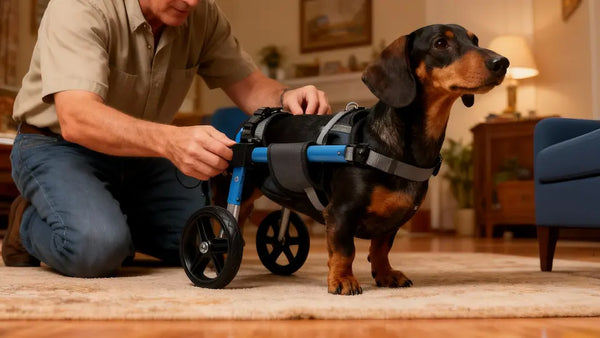
The fix is the two-finger rule, applied before every session — not just when you first set up the wheelchair. Harness straps shift over time. Your dog's body changes with weight fluctuation, muscle development, or seasonal coat changes. A harness that fit perfectly in April may need adjustment in June. For a step-by-step walkthrough of how to check and adjust each contact point, see our fitting guide.
Two fingers between harness and body at every contact point. Every time. This single habit prevents more skin problems than everything else in this article combined.
Cause 2: Wearing the wheelchair too long without breaks
Skin needs airflow to stay healthy. A harness that sits against the skin for two hours straight — even a perfectly fitted one — creates a warm, low-oxygen environment underneath where moisture accumulates and the skin's natural resilience weakens.
The general guideline is to give your dog a break from the wheelchair at least once per hour of continuous use. During the break, the harness comes off completely and the skin gets exposed to air. Even 10 to 15 minutes of harness-off time between sessions makes a meaningful difference. For a realistic sense of how session length typically builds over the first week, the Day 1 to Day 7 guide covers what to expect each day.
For Dachshunds, this is especially relevant along the ventral strip, where the long contact area and low ground clearance (which reduces ventilation from below) create conditions that favour moisture buildup faster than on taller breeds.
Cause 3: Moisture getting trapped under the harness
Wet grass, light rain, puddles, the dog's own sweat-equivalent (dogs dissipate heat through panting and paw pads, but skin moisture still occurs in contact areas) — any of these can introduce moisture under the harness. Moisture softens the skin and dramatically increases the friction coefficient between skin and fabric.
After any session that involves wet surfaces, remove the harness and dry the contact areas with a clean towel before putting it back on for the next session. If the harness material itself is damp, let it dry fully before the next use. This is not something you need to be obsessive about — just aware of it.
Cause 4: Debris under the harness
Grass clippings, sand, small pieces of gravel, dried mud — anything that gets between the harness and the skin acts as an abrasive. Dachshunds are low to the ground, which means they pick up more debris on their underside than a taller dog on the same terrain. After outdoor sessions on anything other than clean pavement, it's worth doing a quick visual check and brushing away any visible debris from the contact areas before the next session.
What Early Irritation Looks Like
Catching it early is everything. Minor irritation resolves in a day or two with simple adjustments. Advanced irritation can mean open sores that require veterinary treatment and a complete break from wheelchair use while the skin heals — which disrupts your dog's routine and sets back the momentum you've built.
Stage 1 — Pink or slightly red skin. The contact area looks mildly flushed compared to surrounding skin. No broken skin, no hair loss. Your dog isn't bothered by it. This is the stage where a fit adjustment, a session length reduction, or better post-session drying resolves it completely within 24 to 48 hours.
Stage 2 — Redness with hair thinning or roughened texture. The skin in the contact area is visibly irritated, and you may notice that the hair is thinner or the skin texture feels rougher than normal. Your dog may lick the area. Adjust the fit, shorten sessions, and keep the area clean and dry. If it doesn't improve within 2 to 3 days, consult your veterinarian.
Stage 3 — Broken skin, raw patches, or open sores. This requires a break from wheelchair use until the skin has healed, and a veterinary consultation to rule out infection and get appropriate treatment recommendations. Do not put the harness back on broken skin.
The goal is to never get past Stage 1. The daily check habit makes this realistic.
The Daily Skin Check Routine
This takes about 60 seconds after each wheelchair session. Run your fingers along the five key contact points and look for any change from normal:
Under the belly strap — run your hand along the full length of the ventral strip. Feel for warmth, moisture, or roughened texture.
Chest crease — lift the front harness strap and check both sides of the crease where it meets the front legs. This is the spot most likely to trap moisture.
Inner thighs — check where the rear harness contacts the upper hind legs. Look for redness or hair thinning.
Back/spine contact area — less common for irritation, but worth checking, especially if the harness has any rigid elements that sit on the back.
Armpit area — the classic chafing zone for any harnessed dog, including Dachshunds.
If everything looks and feels normal, you're good. If any area looks pink or feels warmer than usual, that's your early warning. Adjust the fit at that point, shorten the next session slightly, and recheck the following day.
Cleaning and Harness Maintenance
The harness itself needs regular maintenance — a dirty harness is a rough harness.
Wipe down the harness interior with a damp cloth after every outdoor session, paying attention to any areas where grass, dirt, or moisture has accumulated. Allow it to dry completely before the next use — a damp harness against warm skin is the fastest path to irritation.
Most wheelchair harnesses can be hand-washed with mild soap weekly. Check the manufacturer's care instructions for your specific harness material. Avoid harsh detergents or fabric softeners that can leave chemical residues against the skin.
If the harness fabric has become stiff, rough, or cracked from extended use, it's time to replace it. Harness material degrades over months of daily use, and worn fabric creates more friction than new fabric even at the same fit settings. If you're looking at a full replacement, our Dachshund wheelchair comes with a harness configured specifically for the Dachshund body shape.
Frequently Asked Questions
Q: How often should I check my Dachshund's skin for irritation?
After every wheelchair session during the first two weeks, then at least every few days once you're in a stable routine. The check takes about 60 seconds — run your fingers along the five contact points described above.
Q: My Dachshund has a red spot under the belly strap. Should I stop using the wheelchair?
If the skin is pink or mildly red but not broken, adjust the harness fit (check the two-finger rule), shorten the next session slightly, and ensure the area is dry. This usually resolves within 24 to 48 hours. If the redness doesn't improve in 2 to 3 days, or if the skin is broken, stop wheelchair use at that contact point and consult your veterinarian.
Q: Can I put anything on the skin to prevent chafing?
Some owners use pet-safe balms or barrier creams on friction-prone areas before sessions. If you choose to do this, use only products specifically formulated for dogs and consult your veterinarian for recommendations. Avoid human products, petroleum jelly, or anything with fragrances.
Q: Is irritation more common in short-haired or long-haired Dachshunds?
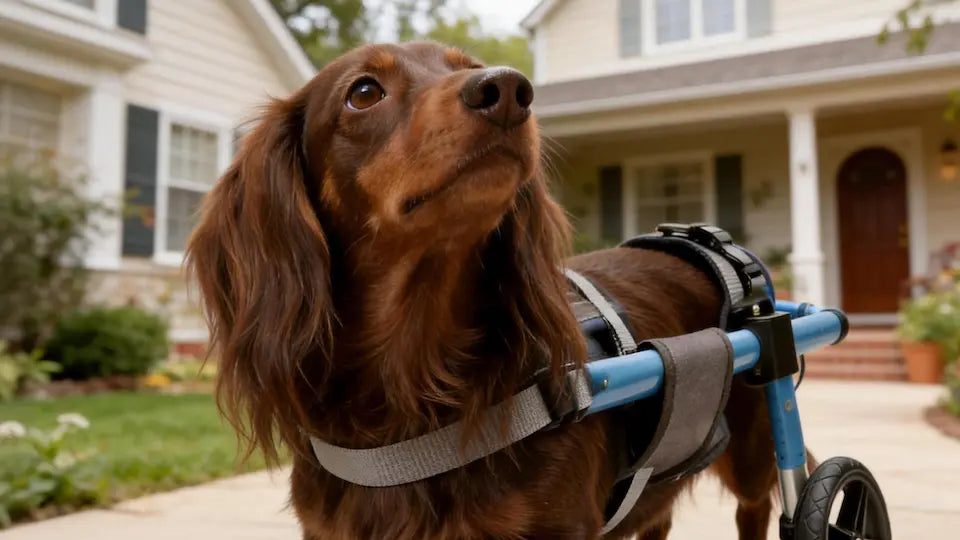
Short-haired (Smooth) Dachshunds tend to be more prone to harness chafing because they have less natural padding between the skin and the harness material. Long-haired and Wire-haired Dachshunds have some natural cushioning from their coat, but are still susceptible — especially in areas where the coat is thinner, like the inner thighs and armpits.
Q: How often should I wash the harness?
Wipe down the interior after every outdoor session. Full hand-wash with mild soap once a week, or more frequently if the harness gets wet or visibly dirty. Always let it dry completely before the next use.