*This article is for informational purposes only and does not constitute veterinary advice. Always consult your veterinarian regarding your dog's specific mobility needs.
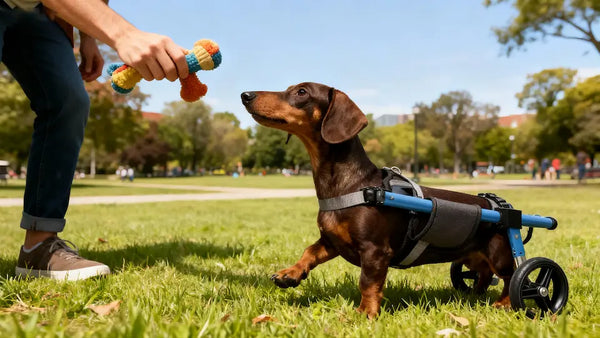
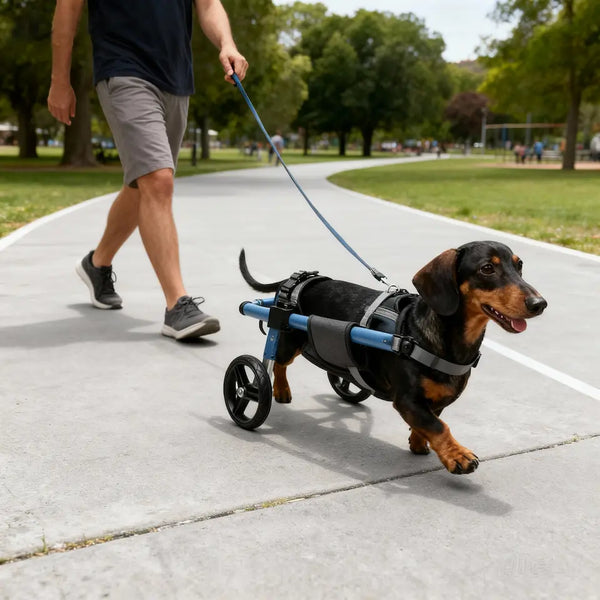
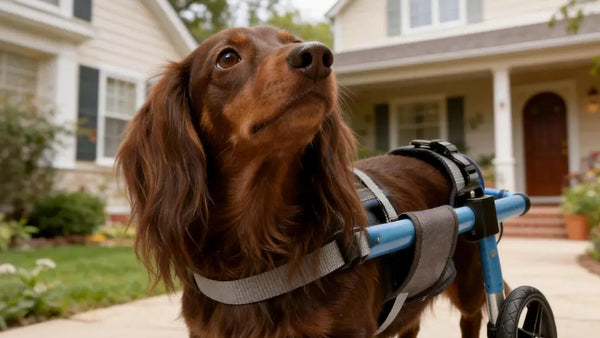
For dogs who use a dog wheelchair for active outdoor sessions, daily walks, and independent movement, there's often a second question that comes up: what about the rest of the day?
A wheelchair is designed for active use — it gives dogs the freedom to move independently for extended periods outdoors. But during shorter indoor movement, rest-to-standing transitions, navigating stairs, or getting in and out of the car, a dog back support vest serves a different and complementary function. It supports your dog during the moments when the wheelchair isn't on, keeping them stable and making owner-assisted movement easier throughout the day.
This guide covers what a back support vest does, when it works best as part of a broader mobility routine, and how to size and fit one correctly.
What a Dog Back Support Vest Does
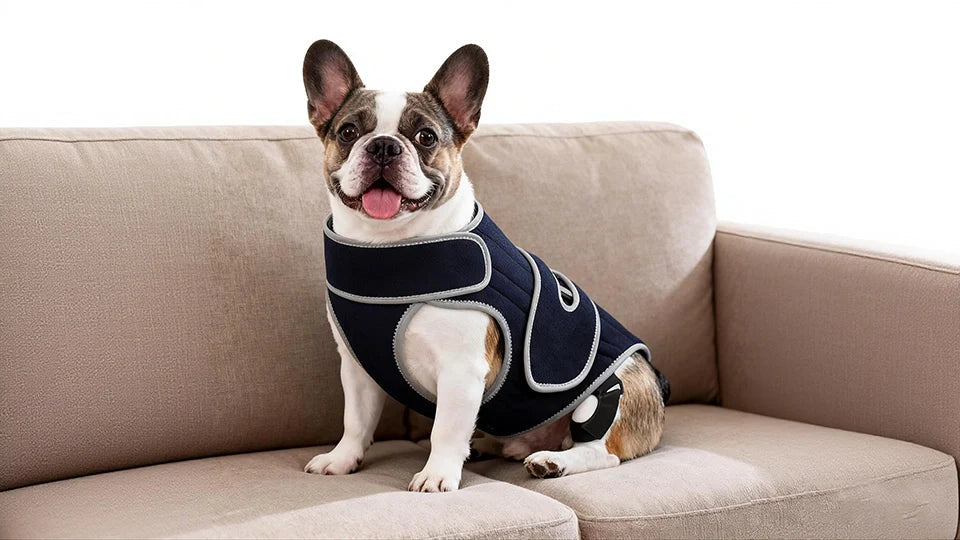
A back support vest is a wearable, adjustable garment that wraps around the dog's torso — covering the back, chest, and hindquarters — to provide structural support during movement. Unlike a wheelchair, which enables fully independent movement for extended periods, a vest works with whatever mobility your dog has during lower-intensity daily activity.
The vest supports the back and core in a natural posture alignment, reduces the physical load on the rear quarters during movement, and gives owners a secure point from which to assist their dog when needed. For dogs who already use a wheelchair, the vest fills in the gaps — the transitions, the short trips, the moments between active sessions.
Most dogs adapt to a vest quickly. It is lightweight, breathable, and straightforward to put on and take off, which makes it practical for the kind of frequent, brief use that complements a wheelchair routine.
How the Vest and Wheelchair Work Together
The most practical way to think about these two aids is that they cover different parts of the day — and different types of movement.
|
Situation |
Wheelchair |
Back Support Vest |
|
Extended outdoor walks and exercise |
✓ Primary tool |
Can be worn underneath |
|
Independent movement for 30+ minutes |
✓ Primary tool |
|
|
Rest-to-standing transitions |
✓ Primary tool |
|
|
Navigating stairs or steps |
✓ Primary tool |
|
|
Getting in and out of vehicles |
✓ Primary tool |
|
|
Short indoor movement between rest periods |
Optional |
✓ More practical |
|
Postural support during calm indoor activity |
✓ Primary tool |
Neither aid replaces the other. A dog who uses a wheelchair for outdoor sessions may benefit from the vest at home for shorter movement and transitions — and the two can be part of the same daily routine. Your veterinarian or a canine rehabilitation specialist can advise on the right combination for your dog's specific situation.
When a Back Support Vest Is Most Useful
The following scenarios reflect the most common situations where owners find a vest valuable as part of a broader mobility routine. Always consult your veterinarian regarding your individual dog's needs.
Between wheelchair sessions
A wheelchair is typically worn during supervised active use — walks, outdoor time, play. Between sessions, when the wheelchair is off, a support vest keeps the dog stable during short indoor movement and makes it easier for the owner to assist if needed. It bridges the gap between full wheelchair support and unsupported movement.
Rest-to-standing transitions
Getting up from a lying or sitting position is one of the more physically demanding moments for dogs with reduced rear leg strength. A vest gives the dog added structure during this transition, and gives the owner a secure point to assist gently without needing to lift the full body weight.
Stairs, steps, and vehicle entry
Dogs who use a wheelchair outdoors often still face mobility challenges at the threshold — the step out of the front door, the stairs to the garden, getting into the car. These are moments that don't require a full wheelchair setup but do benefit from postural support and owner assistance. A vest handles these transitions naturally.
Senior dogs building toward wheelchair use
For senior dogs in the earlier stages of reduced mobility — where a wheelchair may be part of the plan but hasn't been introduced yet — a vest can serve as a useful first step. It supports current mobility while the dog builds toward wheelchair adaptation. As always, your veterinarian is best placed to advise on the right progression for your dog.
How to Size a Dog Back Support Vest
Correct sizing is essential. An ill-fitting vest — too loose, too tight, or incorrectly positioned — provides less support and may cause discomfort during extended wear.
The Pei's Corner back support vest uses four measurements to determine the correct size.
The 4 Measurements
Neck Girth — Measure around the neck at its mid-point, where a collar would typically sit.
Chest Girth — Measure around the widest part of the chest, just behind the front legs. This is usually the largest measurement and the most critical for fit.
Back Leg Girth — Measure around the upper part of one of the hind legs, at its widest point.
Back Length — Measure along the top of the back from the base of the neck (where it meets the shoulders) to the base of the tail.
Size Chart
|
Size |
Neck Girth |
Chest Girth |
Back Leg Girth |
Back Length |
|
S |
8–12 in |
12–20 in |
8–12 in |
11–13 in |
|
M |
12–18 in |
16–28 in |
11.5–18 in |
16–19 in |
|
L |
14–22 in |
22–39 in |
16–23 in |
17–20 in |
|
XL |
18–27 in |
25–46 in |
22–30 in |
22–25 in |
If your dog falls between sizes, use the chest girth as the primary guide — it is the most structurally important measurement for this garment. When in doubt, contact us directly and we can advise on the right fit for your dog's specific measurements.
Fitting the Vest: Key Checks
Once the vest is on, run through these checks before your dog begins moving:
Two-finger clearance. At every point where the vest contacts the body — across the back, around the chest, at the hind leg openings — you should be able to fit two fingers comfortably between the fabric and the skin. Tighter than this, loosen the vest. More than three fingers, tighten it.
Posture check. View your dog from the side. The vest should sit evenly across the back without pulling upward at the rear or bunching forward at the chest. Your dog's natural posture should be maintained.
Movement check. Watch your dog take a few steps. The vest should move with them rather than shifting position. If it slides backward or forward during movement, the fit needs adjusting.
Hind leg openings. The back leg girth openings should sit comfortably around the upper hind legs without restricting movement or digging in. Your dog should be able to extend their hind legs fully during normal movement.
Getting Your Dog Used to the Vest
Most dogs adapt to a support vest within a few days. For dogs who already use a wheelchair, the process is often faster — they are already accustomed to wearing equipment during activity.
A simple approach for the first few sessions:
- Introduce the vest indoors, in a familiar space
- Keep the first session short — 10 to 15 minutes — and stay nearby
- Use treats to build a positive association during fitting and wearing
- Reward calm, normal movement with quiet praise
- Increase session length gradually over the first week based on your dog's comfort
Some dogs are initially uncertain about the sensation around their hind legs. This typically resolves within two to three sessions once they associate the vest with normal movement and daily routine.
Daily Use Guidelines
The back support vest is designed for active use — walks, transitions, and daily activity — rather than extended unsupervised rest.
- Remove the vest during unsupervised rest periods and sleep
- For dogs using both a wheelchair and a vest, a typical day might include: vest for morning transitions and indoor movement → wheelchair for outdoor session → vest again for afternoon indoor activity
- Monitor for any areas of rubbing or skin irritation, particularly around the chest and hind leg openings, and adjust the fit if needed
- Always follow your veterinarian's guidance on daily usage duration for your individual dog
Frequently Asked Questions
Q: Can my dog wear the support vest and use a wheelchair on the same day?
Yes — this is one of the most practical ways to use both aids. The vest covers the lower-intensity parts of the day (indoor movement, transitions, stairs), while the wheelchair covers active outdoor sessions. The two complement each other naturally.
Q: What size back support vest does my dog need?
Use the four measurements — neck girth, chest girth, back leg girth, and back length — and match them to the size chart above. If your dog's measurements span two sizes, use the chest girth as the deciding factor.
Q: How long can a dog wear the support vest each day?
This depends on the individual dog and should be guided by your veterinarian. Many dogs wear the vest during all active indoor periods. Always remove it during unsupervised rest and overnight sleep.
Q: Will the vest restrict my dog's movement?
A correctly fitted vest should not restrict natural movement. The design allows full range of motion in the front and hind legs, with support coming from the torso structure rather than from limiting movement.
Q: My dog already uses a wheelchair. Do they still need a vest?
Not necessarily — but many owners find it a useful complement for the parts of the day when the wheelchair isn't on. Whether it's right for your dog depends on their specific mobility needs and daily routine. Your veterinarian can advise on whether adding a vest makes sense alongside your dog's existing wheelchair use.
Q: Is a support vest suitable for all breeds and sizes?
The vest is available in S, M, L, and XL to accommodate a wide range of breeds. Always size by measurement rather than by breed name or body weight alone.
A Natural Part of the Mobility Routine
For dogs who use a dog wheelchair, a back support vest rounds out the mobility toolkit — covering the transitions, the indoor moments, and the lower-intensity parts of the day that fall outside active wheelchair sessions. Together, they support a fuller range of daily movement.
If you're considering adding a vest to your dog's routine, our Dog Back Support Vest is available in four sizes.