
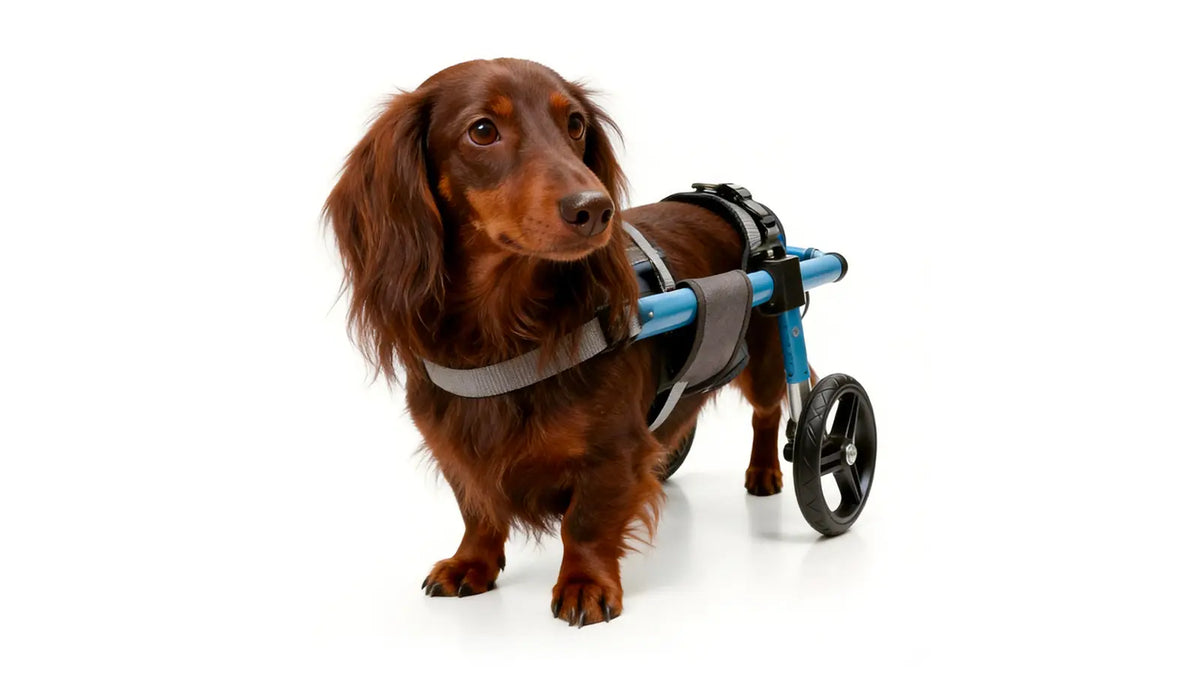
*This article is for informational purposes only and does not constitute veterinary advice. Always consult your veterinarian before introducing any mobility aid to your dog's routine.
If you search "how much does a dog wheelchair cost," you'll find the same answer everywhere: $100 to $700, depending on size and support type. That range is technically accurate and practically useless. It's like being told a car costs somewhere between $5,000 and $80,000.
For Dachshund owners specifically, the picture is narrower than those guides suggest — but also more complicated. Here's why.
Dachshunds are small dogs by weight (under 8 lbs for a Kaninchen, up to 32 lbs for a large Standard), which should theoretically put them in the cheapest size bracket. But their proportions — long spine, deep chest, short legs — don't match the sizing assumptions that most budget wheelchairs are built around. A cart that fits a 15-lb Beagle by weight will almost certainly be wrong for a 15-lb Miniature Dachshund by body length.
That mismatch is where "cheap" quietly becomes expensive.
This article breaks the dog wheelchair market into three actual price tiers, explains what you get and give up at each level, and walks through the cost questions that are specific to Dachshunds — including some that no other pricing guide covers. If you've already decided on a wheelchair and want a full fitting and usage guide, start with The Complete Dachshund Wheelchair Guide.
The Three Price Tiers — and Where Your Money Actually Goes
Every dog wheelchair pricing guide lists individual brands. Very few step back and ask: what kind of product are you actually getting at each price level?
Here's the market as it actually exists right now:
|
Budget ($50–$97) |
Mid-Range ($150–$250) |
Premium ($375–$834+) |
|
|
Typical products |
Unbranded carts on Amazon, Walmart, eBay (KFFKFF, LetPetRun, VEVOR) |
Pei's Corner ($199), Best Friend Mobility refurbished (~$180) |
Walkin' Pets ($219–$529 rear / $539–$834 quad), K9 Carts ($375–$780), Eddie's Wheels ($500–$1,600) |
|
What you get |
Basic aluminum frame, adjustable height/width, free shipping |
Multi-axis adjustability, published size charts, customer sizing support, return policies |
Brand recognition vets trust, custom fabrication (K9 Carts, Eddie's Wheels), long warranties (Eddie's: lifetime) |
|
What you give up |
Sizing support, customer service, breed-specific fitting guidance |
Not a legacy specialist brand — newer companies with shorter track records |
Money and time — custom builds take 1–3 weeks |
|
Best for |
Short-term recovery, standard-proportion breeds, confirmed sizing |
Most families — especially breeds with non-standard proportions |
Complex cases, vet-recommended custom builds, dogs who don't fit adjustable frames |
|
Dachshund fit risk |
High — size charts based on weight alone often miss the long-back proportion |
Low — XS/S/XXS frames with proper measurement accommodate most Dachshund body types |
Low — but the price premium is rarely necessary for a Dachshund |
A few things worth expanding on at each tier:
Tier 1: Budget — $50 to $97
These are not garbage products. For a Pomeranian recovering from knee surgery who needs a cart for 6 weeks, a $70 Amazon cart might be perfectly adequate. For a Dachshund with ongoing mobility challenges who will use this cart daily for months or years, the fit risk is high enough that the "savings" often evaporate on the first return.
The core problem is that budget sizing charts are designed around standard proportions — dogs that are roughly as long as they are tall. A Dachshund's body-length-to-leg-height ratio is so far outside that assumption that the frame length may be inches too short, even when the weight range technically matches.
Tier 2: Mid-Range — $150 to $250
This is where most Dachshund families end up — and it's usually the right call. At Pei's Corner, our dachshund wheelchair is $199 across all three sizes (XXS, XS, and S), covering the full range from Kaninchen to Standard Dachshund body types. If your Dachshund's proportions are especially unusual and don't fit a standard frame, you can send us your measurements and we'll adjust the wheelchair before shipping — still at the same $199 price point.
The presence of actual sizing support is what separates this tier from budget carts. You're not guessing from a weight-only chart — you're working with specific measurements and getting confirmation before the cart ships.
Tier 3: Premium — $375 to $834+
If your veterinarian or certified canine rehabilitation therapist specifically recommends a brand, follow that advice — they know your dog's case. But for a Miniature or Standard Dachshund with rear-leg mobility challenges, a well-fitted mid-range cart does the same job at a fraction of the cost. Walkin' Pets is adjustable (not custom), so the higher price there reflects brand maturity and warranty rather than bespoke fabrication. K9 Carts and Eddie's Wheels are genuinely custom-built, which matters for complex cases — but most Dachshunds don't need that level of customization.
Why Dachshunds Cost Differently: The Body Geometry Problem
Most "how much does a dog wheelchair cost" articles treat all breeds the same. The five factors they list — support type, size, adjustability, wheels, custom vs. standard — are real, but they skip the factor that matters most for Dachshund owners: body geometry.
A 16-lb Miniature Dachshund and a 16-lb French Bulldog are the same weight. They are radically different shapes. The Dachshund's back is roughly twice the length relative to their leg height. That ratio matters for wheelchair fitting because the harness cradle position, the distance between wheel axle and center of gravity, and the frame length all depend on the relationship between trunk length and height — not weight alone.
Here's what that actually looks like across the three Dachshund varieties:
|
Standard Dachshund |
Miniature Dachshund |
Kaninchen (Rabbit) |
|
|
Weight |
16–32 lbs |
11 lbs and under |
Under 8 lbs |
|
Height at withers |
8–9 in |
5–6 in |
4–5 in |
|
Typical body length |
21–25 in |
15–19 in |
12–15 in |
|
Chest circumference |
14+ in |
12–14 in |
Under 11.8 in |
|
Pei's Corner frame size |
XS or S |
XS |
XXS |
Notice the body length column. A Standard Dachshund can be 25 inches long while standing only 8–9 inches tall at the withers. No other breed in the same weight class has proportions anywhere close to that. This is exactly why a budget cart sized by weight alone — "16–25 lbs = Size M" — can land you with a frame that's too short, wheels positioned too far forward, and a dog that tips or drags. For a deeper look at how Miniature and Standard sizing differences play out in practice, see Miniature Dachshund vs Standard Dachshund: Wheelchair Sizing Differences Explained.
What we've seen consistently is that Dachshund owners who start with a budget cart and have to exchange or replace it end up spending $120–$170 total (original cart + return shipping + second cart) — which is more than they would have spent buying a properly fitted mid-range cart the first time.
The progression factor that pricing guides don't mention
This is the cost dimension that no other pricing guide talks about, and it matters for Dachshund owners.
Many Dachshunds start with partial rear-leg weakness — dragging, knuckling, or unsteady gait — and a rear-support two-wheel cart is the right tool at that stage. But mobility challenges in Dachshunds can be progressive. The rear legs may lose more function over time, or front-leg compensation fatigue may set in, and what started as a two-wheel situation may eventually become a four-wheel situation.
If you're budgeting for a Dachshund with mobility challenges, the smart question isn't just "How much is the wheelchair today?" It's "What does the upgrade path cost if my dog needs more support later?"
At Pei's Corner, our rear-support wheelchair is $199. If a dog later needs full-body support, a front-wheel attachment adds $79 — converting the same frame from a two-wheel to a four-wheel setup. That puts the potential total at $278.
Compare that with buying separate carts: a budget rear cart ($70) plus a separate full-support four-wheel cart later ($150–$300) easily totals $220–$370 — and you've dealt with two separate fitting processes.
Not every Dachshund will need the upgrade. But knowing the upgrade path cost before you buy the first cart is the kind of planning that saves real money.
Answer These 4 Questions Before You Pick a Price Tier
Instead of comparing brands, start here. These four questions will narrow your price tier faster than any product table.
1. Which legs need support?
If only the rear legs are affected and the front legs are strong, a rear-support two-wheel cart is almost certainly right. That's the most affordable category across all three tiers. If both ends need support, you're looking at four-wheel carts, which start higher in every tier. Not sure whether your dog is ready for a wheelchair at all? 5 Signs Your Dog Is Ready for a Wheelchair walks through the indicators owners most commonly miss.
2. Is this short-term or long-term?
Post-surgery recovery that's expected to last 4–8 weeks? A budget cart or even a lift harness ($40–$89) may be enough. Daily use for months or years? Invest in a mid-range or premium cart that will hold up under daily wear and fit well enough to prevent skin issues over time. If you're weighing a wheelchair against a support vest, Wheelchair or Support Vest? Getting This Wrong Could Set Your Dog Back Weeks covers exactly that decision.
3. Is your dog's body shape "standard"?
If you own a Dachshund, Corgi, Basset Hound, or French Bulldog — breeds with non-standard trunk-to-leg ratios — the fit risk on budget carts goes up. This doesn't mean you can't use one, but it means the sizing chart deserves extra scrutiny, and you should confirm measurements with the seller before ordering. If the seller doesn't offer sizing support, that's your answer.
4. Could the condition progress?
For Dachshunds with progressive mobility challenges or any breed with degenerative conditions, the honest answer is: possibly. Ask your veterinarian about the likely trajectory. If progression is realistic, factor the upgrade path into your budget — either a front-wheel add-on to your existing cart, or the cost of a second full-support cart later.
If you answered "rear legs only, long-term, non-standard body, possible progression" — which describes a very large share of Dachshund wheelchair buyers — the mid-range tier with an upgrade option is almost always the most cost-effective path.
The Costs That Don't Show Up in the Cart Price
The sticker price is only the starting number. Here's what else can show up on the bill:
|
Cost item |
What it is |
Typical range |
When it applies |
|
Front-wheel attachment |
Converts a 2-wheel rear cart to 4-wheel full support |
$79 (Pei's Corner) to $140–$320 (premium brands) |
If your dog's mobility needs progress beyond rear support |
|
Back support vest |
Trunk support for off-wheelchair moments — car transfers, potty breaks, short walks. |
$69 -$89 |
Useful as a companion tool, not a wheelchair replacement |
|
Return shipping |
The hidden cost of a sizing miss |
$15–$40+ depending on carrier and weight |
Higher risk with budget carts that lack sizing guidance |
|
Replacement straps/padding |
High-wear items that loosen or compress over months of daily use |
$15–$30 |
Every few months with daily use |
|
Vet or rehab consultation |
Confirms the right support type and rules out underlying issues |
Varies |
Essential if mobility loss is sudden, painful, or rapidly worsening |
The practical budgeting rule: if your Dachshund needs daily mobility support, plan for the cart plus at least one companion item (a vest or front-wheel attachment). It's usually cheaper than buying a second cart because the first setup wasn't complete.
Used, Refurbished, and Financial Aid Options
If budget is the barrier between your dog and mobility, these routes are worth exploring:
Refurbished carts: Best Friend Mobility sells factory-refurbished Walkin' Wheels at reduced prices (around $180 for a rear-support Mini at time of writing). Stock and size availability fluctuate, so check back if your size is out.
Used marketplace: UsedDogWheelchairs.com (operated through Walkin' Pets) lists pre-owned carts. The risk is fit — used carts come in the size they come in, and modifications are limited. Measure first, verify all parts are included, and be realistic about whether the available size matches your dog.
Financial aid programs: The Handicapped Pets Foundation donates new or reconditioned wheelchairs to pets in need (application-based). Joey's PAW provides financial assistance for mobility devices. Walkin' Pets maintains a financial-aid resource page aggregating available programs.
Pet insurance: Some policies cover medically necessary mobility devices when prescribed by a veterinarian. Trupanion, for example, has stated that mobility aids can be eligible for coverage under certain conditions. If you already carry coverage, check with your provider before paying out of pocket.
These options are not instant solutions — applications take time, used stock is unpredictable — but they're real paths that have helped real families. A lift harness ($40–$89) can serve as a bridge tool while you wait.
FAQ
What's a realistic budget for a Dachshund wheelchair?
Most Dachshund owners spend $150–$250 on a properly fitted rear-support cart. If your dog later needs a front-wheel upgrade for full-body support, add $79–$320 depending on brand. Budget $250–$350 as a "full journey" number, and you'll be covered for the majority of scenarios.
Can I just buy a $60 wheelchair from Amazon for my Dachshund?
You can, and for some dogs it works out fine. The risk for Dachshunds specifically is that budget size charts are built around standard proportions, and Dachshund proportions are not standard. If the frame length is wrong for your dog's long back, you'll spend time and money returning and re-buying. Confirm that the cart's body length range — not just weight range — matches your Dachshund before ordering.
Why are Walkin' Pets and K9 Carts so much more expensive?
Different value propositions. Walkin' Pets ($219–$834) offers an established brand, large customer support team, and 5-year frame warranty. K9 Carts ($375–$780) custom-builds each wheelchair to your dog's exact measurements. Eddie's Wheels ($500–$1,600) adds lifetime warranty and hand fabrication. Whether that premium is worth it depends on your dog's specific needs — not every dog requires a custom build.
My Dachshund only has mild rear-leg weakness right now. Should I buy a wheelchair or wait?
Talk to your veterinarian about what to expect. If your vet expects the weakness to stay mild, a back support vest ($89) might be enough for now. If your dog's mobility is likely to decline further, getting a rear-support wheelchair sooner rather than later helps your dog adapt while they're still confident on their front legs — making the adjustment period shorter and easier. Muscles and tissue that aren't bearing weight can begin to weaken relatively quickly (Millis & Ciuperca, 2015, PubMed 25432679), so early support has practical value. Day 1 to Day 7 in a Dog Wheelchair gives an honest account of what that first week actually looks like.
Does Pei's Corner cover all Dachshund sizes?
Yes. Our Dachshund Wheelchair comes in XXS, XS, and S — covering Kaninchen, Miniature, and Standard Dachshund body types respectively. All three sizes are $199. If your Dachshund's proportions are especially unusual and fall outside our standard frame ranges, you can send us your measurements and we'll adjust the wheelchair accordingly before shipping, at the same $199 price.
How do I avoid buying the wrong size?
Measure, don't guess. The three measurements that matter most for Dachshunds: height from ground to the hip joint (not the top of the back), chest girth at the widest point, and body length from base of neck to base of tail. Weight alone is not enough — two 15-lb dogs can have completely different frame needs. Send your measurements to the seller and ask for size confirmation before ordering. If the seller doesn't offer that service, consider it a red flag.
Do Dachshund wheelchairs require any special maintenance?
Daily: quick skin check on your dog where the harness contacts the body (armpits, groin, chest). Weekly: inspect straps for wear and wheel condition. Monthly: check all adjustment points and tighten if needed. Replace padding or straps when they show compression or fraying — usually every few months with daily use.
Sources referenced in this article:
-
Evidence for Canine Rehabilitation and Physical Therapy. Veterinary Clinics of North America: Small Animal Practice, 45(1), 1–27. PubMed 25432679.
-
Walkin' Pets published pricing: walkinpets.com (rear $219–$529, quad $539–$834). Accessed May 2026.
-
K9 Carts published pricing: k-9cart.com (rear from $375, full support from $675). Accessed May 2026.
-
Eddie's Wheels published pricing: eddieswheels.com (rear $500–$900, quad $1,200–$1,600). Accessed May 2026.
-
OrthoPaws published pricing: orthopaws.com ($450–$2,800). Accessed May 2026.
-
AKC breed profile: Dachshund. akc.org. Accessed May 2026.