*This article is for informational purposes only and does not constitute veterinary advice. Always consult your veterinarian before selecting a mobility aid for your dog.
Most wheelchair sizing guides handle Dachshunds in a single line: "Dachshund — XS." As if a 9 lb Miniature and a 28 lb Standard are the same dog who just ate a bigger breakfast.
They're not. From a wheelchair fitting perspective, the difference between a Miniature and a Standard Dachshund is roughly equivalent to the difference between a Chihuahua and a Beagle. Same breed name, same iconic silhouette, completely different frame requirements.
This is the comparison that no other wheelchair brand publishes — and it's the reason a surprising number of Dachshund owners end up with a wheelchair that doesn't fit properly on the first try.
How Different Are They, Really?
More different than most people expect. Here are the actual body dimensions side by side, including the Kaninchen (Rabbit) Dachshund for owners in countries where this type is recognized.
| Body measurement | Kaninchen (Rabbit) | Miniature | Standard |
|---|---|---|---|
| Weight | Under 8 lbs | Under 11 lbs | 16–32 lbs |
| Height at withers | 4–5 in | 5–6 in | 8–9 in |
| Typical body length | 12–15 in | 15–19 in | 21–25 in |
| Chest circumference | Under 12 in | 12–14 in | 14+ in |
Sources: AKC breed standards (Standard & Miniature); FCI breed standards (Kaninchen).
A Standard Dachshund can be nearly double the height and triple the weight of a Kaninchen. Put differently: if you handed someone these measurements without the breed name, they would assume you were describing two completely different dogs.
Which Frame Fits Which Dachshund
Each type maps to a specific wheelchair frame. The frame dimensions are engineered to accommodate the body proportions in the table above — not just the weight.
| Frame | Height range | Width | Length range | Weight capacity | Fits |
|---|---|---|---|---|---|
| XXS | 4-5 in | 3.5-4 in | 9–12 in | 5–9 lbs | Kaninchen |
| XS | 5-8 in | 4-6.5 in | 12–15 in | 9-16 lbs | Miniature |
| S | 8-9 in | 5-9 in | 16-19 in | 16-35 lbs | Standard |
Source: Pei's Corner Dachshund wheelchair size chart. Custom sizing available for dogs whose measurements fall outside these ranges — contact us with your three measurements.
Find your Dachshund type in the right column, then confirm that your dog's actual measurements fall within the height, width, and length ranges for that frame. If they do, that's your frame.
The Three Things That Make the Fit Different
Height: where millimeters matter
A Miniature Dachshund's legs are 5 to 6 inches tall. A Kaninchen's can be as short as 4 inches. At these heights, the margin for error in wheel positioning shrinks to almost nothing. Set the wheels 1 cm too high and the rear end lifts unnaturally. Set them 1 cm too low and the hindquarters aren't properly supported. The spine tilts, the dog feels it immediately, and they freeze.
A Standard at 8–9 inches has a little more room to work with — but "a little more" is relative. Compared to a Labrador at 22 inches, even a Standard Dachshund is operating with very tight tolerances.
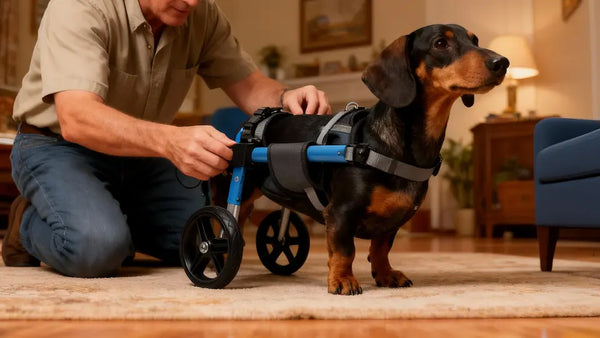
This is why the spine check is the first thing you do after fitting, regardless of which type you have. View from the side. The spine should be a perfectly horizontal line from shoulder to hip. If it isn't, adjust wheel height until it is. For Miniatures and Kaninchens, use the smallest available increments.
Body length: the measurement everyone underestimates
People expect a small dog to have a short torso. Dachshunds break this expectation completely. A Miniature at 9 lbs can have a body length of 19 inches — longer than many dogs twice their weight. A Standard can reach 25 inches.
When the frame is too short for the torso — which happens frequently when sizing is based on weight rather than measurement — the harness bunches up near the hind legs. This restricts movement and creates pressure that the dog immediately resists. It's the second most common fitting error for this breed, after incorrect wheel height.
The body length measurement runs from the centre of the rear thigh to the point where the front leg meets the shoulder. Measure along the side of the body, not underneath. And don't estimate — measure. The Dachshund torso is longer than you think it is.
Weight: it determines structural capacity, not just size
A 28 lb Standard Dachshund exerts meaningful force on the wheelchair frame during movement — turns, uneven ground, sudden direction changes. The XS frame is rated to 18 lbs. It might physically accommodate a 22 lb dog's body dimensions, but it's not engineered for the sustained forces that a heavier dog generates.
This is why weight capacity matters independently of physical dimensions:
- Kaninchen (under 8 lbs): XXS frame — rated to 10 lbs, providing comfortable headroom
- Miniature (under 11 lbs): XS frame — rated to 18 lbs, well within capacity
- Standard (16–32 lbs): S frame — rated to 35 lbs, accommodating the full Standard weight range
For Standards at the lighter end — say, 16 to 18 lbs — body dimensions might theoretically fit an XS frame. But the XS weight capacity tops out at exactly 18 lbs, leaving zero margin for the dynamic forces of actual movement. The S frame is the safer choice.
The In-Between Dogs
Not every Dachshund fits neatly into one category. A 14 lb Dachshund — heavier than the Miniature standard, lighter than the Standard range — is sometimes called a "tweenie" by breeders. A Standard at exactly 18 lbs sits right on the boundary between XS and S frame capacity.
When this happens, use height as the tiebreaker:
- Shoulder height under 9 inches → XXS frame
- Shoulder height 9.1 to 13 inches → XS frame
- Shoulder height 13 inches or above → S frame
If you're genuinely unsure, contact us at contact@peiscorner.com with all three measurements. We can recommend the right frame — and for dogs with truly non-standard proportions, custom sizing is available.
How to Take the Three Measurements
The technique is the same for all three Dachshund types. What changes is the precision required at smaller scales.
Height (withers to ground). Have your Dachshund stand on a flat, hard surface. Measure from the floor straight up to the highest point of the shoulder blade. One tip that makes a real difference for Miniatures and Kaninchens: use a rigid ruler rather than a soft tape. Soft measuring tape flexes and curves at short distances, and at 5–6 inches, that flex can introduce enough error to affect frame selection.
Body length (rear thigh to front shoulder). Run the tape along the side of the body — not underneath — from the midpoint of the rear thigh to where the front leg meets the shoulder. Do not measure from the base of the tail. This is the measurement that trips up the most first-time Dachshund owners, because the number always comes back longer than expected.
Body width (widest point). Measure across the widest part of the body viewed from above. For every Dachshund type, this is almost always the chest rather than the hips — a quirk of the breed's deep, barrel-shaped ribcage.
For illustrated step-by-step instructions, see our Measuring Guide.
A Note on Kaninchen Dachshunds
Kaninchen — or Rabbit Dachshunds — are recognized by the FCI but not the AKC, so they're less common in the United States. They're the smallest of the three types, typically under 8 lbs with a shoulder height of just 4–5 inches.
The XXS frame covers the Kaninchen range, with height as low as 6 inches, length of 9–12 inches, and weight capacity of 5–10 lbs. Because the ground clearance is so low at this size — we're talking about wheels sitting 4 to 5 inches off the ground — the precision of the height measurement is at its most critical. A difference that's negligible for a Standard becomes significant for a Kaninchen.
If you have a Kaninchen at the very smallest end of the range, custom sizing is available to ensure the frame can reach the exact height your dog needs.
Frequently Asked Questions
Q: Can a Miniature Dachshund use the same wheelchair as a Standard?
No. They require different frames. A Miniature uses the XS (height 9.1–13.8 in, capacity 11–18 lbs), a Standard uses the S (height 13–17.3 in, capacity 22–35 lbs). The height ranges, length ranges, and weight capacities don't overlap enough for one frame to serve both types.
Q: My Dachshund weighs 14 lbs. Is that a Miniature or a Standard?
By AKC standards, Miniatures are under 11 lbs and Standards are 16–32 lbs. A 14 lb dog falls between the two — often called a "tweenie." For wheelchair sizing, take the three measurements and match against the frame chart. Height is the most reliable deciding factor.
Q: My Dachshund's measurements don't fit neatly into one size. What do I do?
Contact us at contact@peiscorner.com with your three measurements. We can recommend the right frame and arrange custom sizing if needed for non-standard proportions.
Q: How do I know the fit is correct once it arrives?
Three checks: spine is horizontal from the side, two fingers fit between harness and body at every contact point, and hind paws clear the ground during movement. If any check fails, adjust before the next session.
Q: Can the wheelchair be upgraded later?
Yes. The frame is fully adjustable for height, length, and width at home. It can also be upgraded from rear support to full 4-wheel support with the front attachment.
References
- American Kennel Club. Dachshund Breed Standard. Accessed May 2026.
- Fédération Cynologique Internationale. FCI Standard No. 148: Dachshund. (Kaninchen classification.)