*This article is for informational purposes only. Always consult your veterinarian before starting any new activity routine with your dog.
One of the most common questions from owners who are new to dog wheelchairs is a simple one: what can we actually do together now?
The answer, for most dogs, is more than you might expect. A wheelchair changes how a dog moves — it doesn't change what a dog enjoys. The same interests, the same social instincts, the same pleasure in outdoor exploration that defined your dog before the wheelchair remain intact after it.
This guide covers five activities that work well for wheelchair-assisted dogs, along with practical notes on how to introduce each one, and two activities to avoid for safety reasons.
What Makes an Activity Suitable for a Wheelchair Dog
Before diving into specifics, it helps to understand what you're looking for in a suitable activity.
Smooth or manageable surfaces. Wheelchair wheels perform best on flat pavement, short grass, and firm ground. Activities that take place on these surfaces are accessible from early on. Rough terrain, deep sand, and uneven ground are gradual progressions for later.
Low collision risk. A wheelchair extends your dog's physical footprint significantly. Activities in tight spaces, crowded environments, or situations where sudden direction changes are required work better once your dog has developed spatial awareness with the wheelchair.
Appropriate pace. Wheelchair dogs tire differently than dogs moving under their own power. Activities with natural pauses — sniff walks, social time, casual fetch — tend to suit wheelchair dogs better than sustained high-intensity exercise.
With those principles in mind, here are five activities that consistently work well.
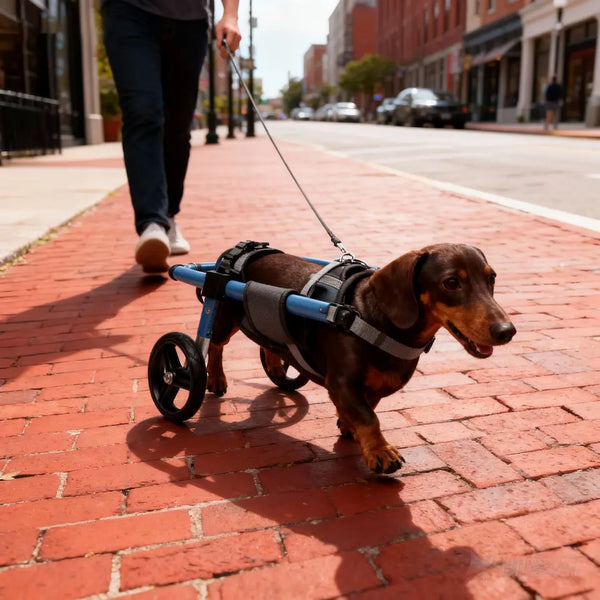
Activity 1: The Sniff Walk
Best for: All wheelchair dogs, from the first week onward Surface: Pavement, short grass, park paths
The sniff walk is exactly what it sounds like — a walk where the pace is set entirely by the dog's nose rather than by distance or time. Your dog stops when they want to stop, investigates what they want to investigate, and moves on when they're ready.
For wheelchair dogs, the sniff walk is particularly well-suited because it removes pace pressure entirely. There's no expectation of covering ground. The dog is simply exploring — and the wheelchair is incidental to that exploration.
A 20-minute sniff walk through a familiar neighbourhood or park provides genuine mental engagement alongside physical movement. Mental stimulation through scent work is genuinely tiring for dogs in the best possible way — most dogs return from a good sniff walk noticeably more settled than after a brisk exercise walk.
Practical notes:
- Use a longer lead (3–5 metres) to give your dog room to veer toward interesting scents without you having to reposition constantly
- Flat, well-maintained paths are ideal for early sniff walks; save uneven terrain for when your dog is fully comfortable with the wheelchair outdoors
- There's no minimum or maximum distance — follow your dog's lead entirely
Activity 2: Gentle Fetch with Soft Toys
Best for: Dogs who enjoy retrieving; works well from week two onward Surface: Indoor (carpet or smooth floor), short grass outdoors
Fetch with a soft toy works naturally with a wheelchair because it creates purposeful forward motion — the dog has a reason to move, rather than just responding to encouragement. For dogs who have always loved retrieving, this is often one of the first activities that reconnects them with something they genuinely enjoy.
The key difference from standard fetch is scale. Short throws — two to four metres — across a familiar surface work better than long-distance throws that require sustained running or sharp direction changes. The goal is enjoyable, manageable movement rather than maximum activity.
Practical notes:
- Soft toys are preferable to hard balls, which can roll unpredictably and require more complex wheel manoeuvring to follow
- Indoor fetch on carpet gives dogs good traction with the wheelchair wheels — a useful starting point before moving this activity outside
- Watch for signs of fatigue: slowing down, less enthusiasm for the retrieve, or sitting down in the middle of the session. A short, enthusiastic session is better than a long one that ends with your dog tired and reluctant
Activity 3: Social Time with Familiar Dogs
Best for: Social dogs with established canine friendships Surface: Garden, open park space, familiar outdoor area
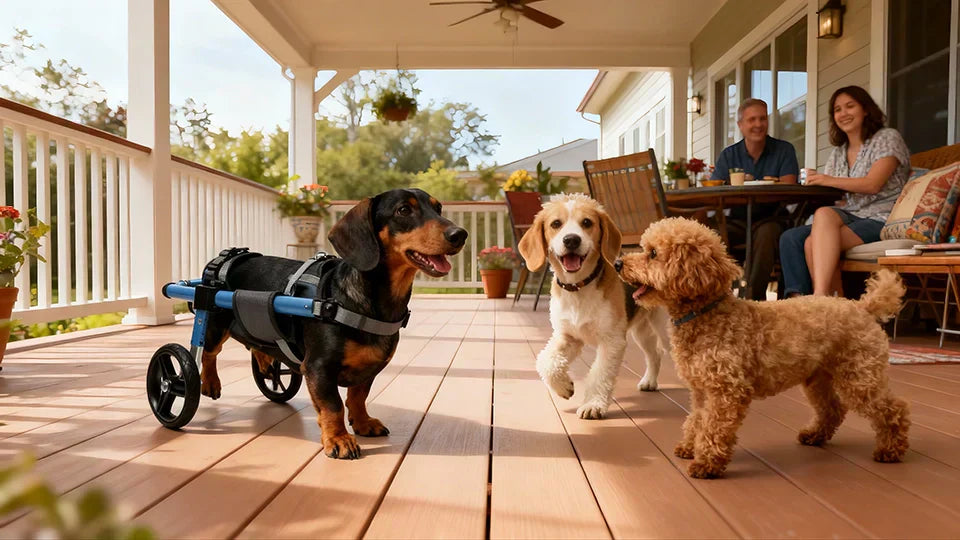
Dogs are social animals, and the wheelchair doesn't change that. Most dogs can continue spending time with canine friends — including gentle interactive play — once they've had a week or two to build confidence with their wheels.
The first meeting between a wheelchair dog and their canine friends is worth managing carefully. Other dogs will be curious about the wheelchair and will want to investigate it. This is normal and usually resolves quickly. Give the dogs space to sniff each other and the wheelchair at their own pace, without rushing the interaction.
Once the initial curiosity has passed, most dogs settle into their normal social dynamic. The wheelchair becomes background context rather than the centre of attention.
Practical notes:
- Choose familiar dogs for early social sessions rather than new introductions. Familiar relationships reduce the variables.
- Open outdoor spaces work better than enclosed areas where the wheelchair may feel restrictive
- Supervise throughout, particularly in the first few sessions. Watch for any dog — wheeled or otherwise — showing signs of overstimulation or stress, and give everyone a break if needed
- Avoid crowded dog parks in the early weeks. The combination of unfamiliar dogs, unpredictable movement, and tight spaces is more manageable once your dog is fully comfortable with the wheelchair
Activity 4: Scent Games Indoors
Best for: All dogs, particularly on rest days or in poor weather Surface: Any indoor floor
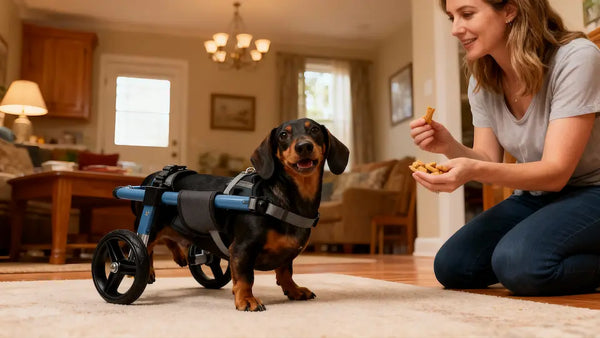
Scent games — hiding treats or a favourite toy and letting your dog find them — are one of the most effective forms of mental enrichment available to dogs, and they work just as well with a wheelchair as without.
The simplest version: while your dog waits in another room, hide several small treats around a room at floor level (under the edge of a rug, behind a chair leg, along a skirting board). Then let your dog in and watch them work. The combination of nose-led searching and independent movement is genuinely engaging.
For wheelchair dogs, indoor scent games have an additional benefit: they build confidence navigating the wheelchair around furniture and in tighter spaces, in a low-pressure context where the dog is motivated by their own curiosity rather than by you guiding them.
Practical notes:
- Start with easy hides and increase difficulty gradually as your dog's confidence grows
- Clear obvious obstacles from the room before the game — trailing cables, anything the wheelchair wheels could catch on
- Keep sessions to 10–15 minutes; scent work is more cognitively tiring than it appears
Activity 5: Exploring New Environments
Best for: Dogs who have completed 2–3 weeks in the wheelchair and are comfortable outdoors
Surface: Varied — introduce gradually
New environments are engaging in a way that familiar ones simply aren't. A dog who has been walking the same neighbourhood path for weeks will typically show noticeably more interest and energy when introduced to a new park, a different street, or an unfamiliar outdoor space.
For wheelchair dogs, new environments serve a dual purpose: they provide genuine mental stimulation through novelty, and they give your dog practice navigating different surfaces and layouts with their wheels. Both are valuable.
Suggested progression:
|
Weeks in wheelchair |
Suitable new environments |
|
Weeks 1–2 |
Familiar outdoor spaces on flat pavement |
|
Weeks 3–4 |
New neighbourhood streets, quiet parks |
|
Month 2+ |
Varied terrain, busier environments, beach on firm sand |
Introduce new environments at a pace that feels comfortable for your dog rather than on a fixed schedule. Some dogs progress faster, some slower — both are normal.
2 Activities to Avoid
Avoid: Stairs and steps
Stairs are not navigable in a wheelchair and shouldn't be attempted. The geometry of a staircase — requiring each leg to work independently at different heights — is incompatible with the wheelchair frame. Remove the wheelchair and assist your dog manually whenever stairs are necessary.
This applies to garden steps, doorsteps with significant height, and kerbs that are too steep for the wheels to roll over smoothly. Small kerbs on flat pavement are typically fine once your dog has developed outdoor confidence.
Avoid: Swimming and water entry
The wheelchair should never be worn in pools, lakes, streams, or anywhere your dog might enter water beyond a shallow puddle. The frame adds significant weight, reduces buoyancy, and creates a tipping risk that makes even a shallow body of water dangerous.
If your dog enjoys water and you want to continue water-based activities, always remove the wheelchair completely beforehand and ensure you have full control of your dog near any water.
Building an Activity Routine
Most wheelchair dogs benefit from a structured daily routine that combines physical movement with mental engagement. A simple framework that works well:
Morning: Sniff walk (20–30 minutes) — physical movement and outdoor mental stimulation
Midday: Short indoor session — scent game or gentle fetch (10–15 minutes)
Afternoon/Evening: Social time or neighbourhood exploration (20–30 minutes)
Adjust session lengths based on your dog's energy levels and veterinarian guidance. The goal is consistent daily engagement across a range of activities — variety keeps dogs mentally stimulated as well as physically active.
For guidance on how long your dog should spend in the wheelchair each day, see our Daily Life guide.
Frequently Asked Questions
Q: How soon can a wheelchair dog start playing with other dogs?
Most dogs are ready for supervised social time with familiar dogs after one to two weeks in the wheelchair, once they're moving with reasonable confidence. Introduce the social situation calmly and let the dogs set the pace of the interaction.
Q: Can a wheelchair dog go to the beach?
Firm, damp sand near the waterline is generally manageable for wheelchair dogs with outdoor experience. Dry, loose sand is significantly harder for wheels to navigate and is better saved for later. Always remove the wheelchair before any water entry.
Q: My dog seems less interested in activities since getting the wheelchair. Is this normal?
Some reduction in enthusiasm during the first one to two weeks is normal — your dog is adjusting to a new way of moving and expending energy on coordination. Sniff walks and scent games tend to re-engage dogs during this period because they're driven by the dog's own curiosity rather than by external prompts. If reduced engagement persists beyond two to three weeks, consult your veterinarian.
Q: How long should each activity session be?
Start with 15–20 minutes per session and adjust based on your dog's response. Most dogs are comfortably active for 2–4 hours per day in multiple sessions once they've fully adapted to the wheelchair. Short, positive sessions are always preferable to long ones that end in fatigue.
Q: Are there activities that are better for dogs with front leg wheelchairs?
Dogs in front-support wheelchairs follow broadly the same activity guidelines, with additional attention to front leg clearance on uneven surfaces. Sniff walks and scent games work particularly well because they don't require sustained forward speed.
For more on daily wheelchair routines, visit our Day 1 to Day 7 guide and Daily Life with a Dog Wheelchair.